Jumat, 03 Februari 2006

Nam June Paik


Nam June Paik died yesterday.
Few artists deserve the name of avant-garde artists as much as Paik did. His faith in the intimate link between technology and art was one of the fundaments of today's new art. Starting off in the early 60's, he was first more connected to live performance. In the 80's he moved towards large multi-monitor installations. He gave technology a soul. He made art seem fun and intelligent at the same time. At times it seemed as if the fun, experimental and/or esoteric aspects took over, leaving less room for intellectual aspects, but even those works had a power that mesmerized, hypnotized and inspired a whole generation of artists. Actually, come and think of it, he inspired more than a generation, since his works are still seen today as innovative and fresh.

Here is an excerpt from New Media in Art:

The (...) 'art'-oriented video histories will usually point to the day in 1965 when Korean-born Fluxus artist and musician Nam June Paik bought one of the first Sony Portapak video sets in New York, and tuyrned his camera on the Papal entourage that day making its way down Fifth Avenue. That, in this view, was the day video art was born. Paik apparently took the footage of the Pope, shot from a cab, and that night showed the results at an artists' hangout, the Cafe a GoGo.
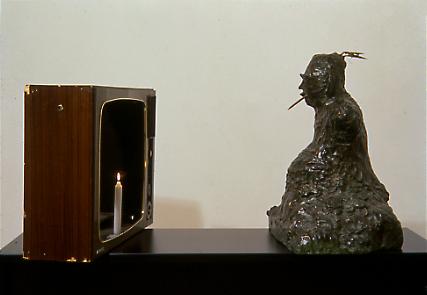

more about Nam June Paik:

Sound Gardens

Hello again!

Here is something that has been around for some time as an idea, with a few small-scale realized projects - but now it seems to be growing quite fast.
The Tactical Sound Garden is an environment (i.e. potentially a physical space of any city) where users of devices such as iPods and other portable sound systems with wireless communication can discover the sounds implanted by others.
In practice this means one walks into a space and hears different sounds. As one moves along, the sounds (songs, noises, voices?) change, new ones appear.

The Tactical Sound Garden [TSG] Toolkit is a vehicle for exploring this via the design of an infrastructure: an open source software platform for cultivating public "sound gardens" within contemporary cities. It draws on the culture and ethic of urban community gardening to posit a participatory environment where new spatial practices for social interaction within technologically mediated environments can be explored and evaluated. Addressing the impact of mobile audio devices like the iPod, the project examines gradations of privacy and publicity within contemporary public space.


Several interesting points about this sort of developments:
- A walkman stops being a synonym of alienation. It can become a shared experience.
- The trust in human goodness is boundless. As the average age of an iPod user (or, what's more significant, a "qualified user") drops, these Gardens, invisible to a common passer - by who might have pu social pressure to keep it tidy, can very well become depositories of some of the most uninspiring sound garbage. ("NOT INCLUDED in the Toolkit are regulations for governing the use (or abuse) of the garden. This is left to the gardeners to sort out. TSGs are intended as self-organizing systems.")
- The audio part of space suddenly becomes a brave new world. It will create specific, isolated communities that are a gem to any advertiser: they have money and time to spend. I wouldn't be surprized, then, if this artistic endeavor soon took on a new twist and became a sort of a commercial radio, where one can discover the wonderful soundscapes for the modest price of having them brought to you by "Chico-Chico, the chocolate that makes it all sound great".
- What exactly is a sound garden? Or rather, what can it be? Are there some possibilities we haven't thought of yet? Rhythms? Conversations? Plays? Games? Dances in public spaces? Lessons? What else?